AI for Rydberg-Atom Quantum Simulation
Abstract
Quantum machine learning is currently at a pivotal moment of innovation in both hardware and algorithms. This project aims to establish a two-way communication channel between a Rydberg-atom-based quantum processor—currently under development at CINN—and theoretical teams whose methods are specifically tailored to, and validated for, this architecture.
The multi-level structure of this Rydberg platform, its programmable connectivity, and its analogue computing capability allow real-world problems to be encoded natively, avoiding decomposition into logic gates and accelerating the process towards ‘quantum advantage’ in the NISQ era.
AI/AA tools are fundamental on both sides of this cycle, enabling us to tackle challenges both in the hardware (limited coherence times, sensitivity to ambient noise, the need for precise laser control, etc.) and in the more theoretical aspects (scalability of quantum Monte Carlo simulations, imposition of symmetries in ansatzes, or even the general understanding of quantum machine learning algorithms).
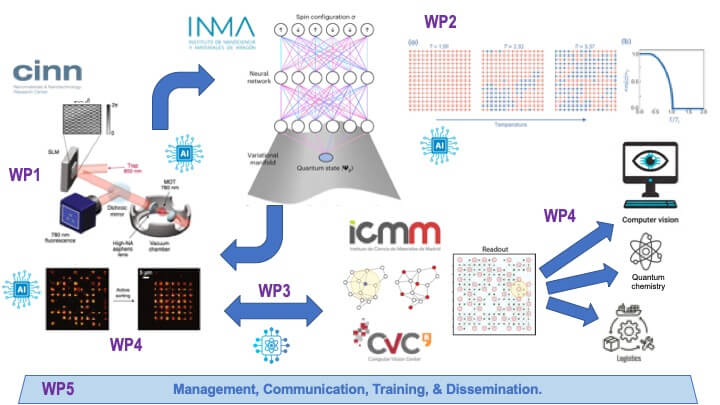
Reinforcement learning controllers will be used to adjust atom cooling and trapping protocols in real time, and neural networks will be employed to accelerate the generation of high-quality holograms for rapidly reordering atoms. Furthermore, experimental data will feed back into theoretical modelling
We pursue four closely interlinked objectives:
- AI for the improvement of quantum hardware: implementing reinforcement learning to optimise the cooling and trapping of atoms, developing neural networks to replace traditional hologram generation algorithms, and for the efficient 3D spatial distribution of neutral atoms;
- ML-enhanced theoretical quantum simulations based on vision transformers as ansatz, and advanced variational Monte Carlo schemes, which will enable the generation of solutions to the physical problem that serve as a reference for experimental quantum simulations, facilitating quantitative validation and system diagnostics;
- Hardware-compatible quantum algorithms for Machine Learning and Optimisation: all proposed algorithms will be co-designed with the native operations of a Rydberg platform, ensuring their experimental implementation and enabling empirical feedback on compilation, error mitigation and control strategies;
- Contextual application in strategic domains: exploring avenues for applications in fields such as quantum chemistry, computer vision and others, demonstrating their potential to address real-world challenges. In particular, this will also enable the creation of a feasible roadmap for research into quantum machine learning in the field of computer vision, paving the way for a programmatic prioritisation of future research. This iterative process—design > implementation > evaluation > refinement—will accelerate the maturation of the hardware, refine theoretical models and position Spain at the forefront of practical quantum technologies with a wide-ranging social impact.
From the laboratory to the computer, and back again
The project has been designed with a multi-site, multi-regional structure that will draw on the expertise of each working group. Coordination is therefore managed by CINN, which already hosts a laboratory working with Rydberg atoms. This laboratory will serve as the project’s experimental hub, the facility where the previously designed quantum simulation protocols will be physically tested.
Project Details
Call: PN2025 – Proyectos en Inteligencia Artificial
Project Code: AIA2025-163435-C41
Duration: 01/12/2025-30/11/2029
Grant: 395.000 €
Principal Investigator: Miguel Pruneda
Funding Project AIA2025-163435-C41 funded by:

Consortium