ELPHBIG-Electron-phonon coupling at interfaces
Abstract
Traditional theoretical models of electronic and phononic properties in solids are based on infinite, perfect crystals, whilst real materials feature interfaces, nanostructures and defects that break translational symmetry. Although modern experimental techniques are now capable of characterising these effects at the atomic scale, current computational methods still struggle to simulate such large and disordered systems.
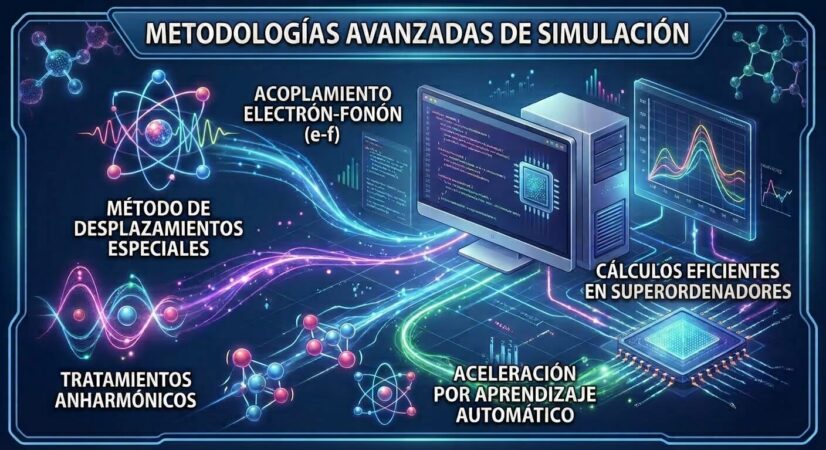
To bridge this gap, this project will develop advanced methodologies for simulating electron-phonon (e-ph) coupling in large-scale, realistic systems, combining new approaches and utilising machine learning-driven acceleration to extend e-ph modelling to realistic nanostructures.
Main Objectives:
Oxide Interfaces: To identify local vibrational modes in order to understand the microscopic mechanisms underlying interfacial superconductivity.
Defects in Semiconductors: To quantify non-radiative recombination by considering out-of-equilibrium e-f dynamics.
2D Materials and Moiré Systems: To develop efficient methods for calculating e-f interactions and anharmonic effects.
Impact
By combining atomic-scale experimental characterisation with real-scale predictive models, the project will provide a versatile platform for the design of quantum materials, driving applications in optoelectronics, nanoscale devices and condensed matter physics.
Project Details
Call: Proyectos de Generación de Conocimiento 2025
Project Code: PID2025-175325NB-I00
Duration: 2026-2029
Funding: 150.000 €
PI: Miguel Pruneda
Funding Ministry of Science, Innovation and Universities