Twistoptics in planar heterostructures with an arbitrary number of rotated three-dimensional thin layers and two-dimensional conductive sheets
Publication Details
Journal: Phys. Rev. B 114, 045423
Authors: Christian Lanza; José Álvarez-Cuervo; Kirill V. Voronin; Gonzalo Álvarez-Pérez; Aitana Tarazaga Martín-Luengo; Javier Martín-Sánchez; Alexey Y. Nikitin; Pablo Alonso-González
Impact Factor: 3,9
Abstract
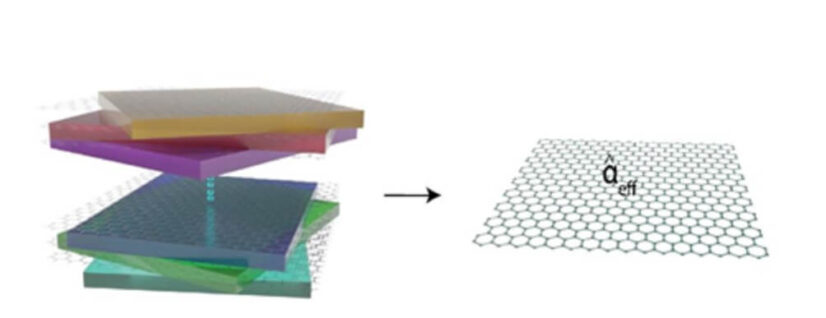
Twistoptics has recently emerged as a branch of nano-optics that explores light propagation in stacks of thin anisotropic layers rotated relative to one another. The concept is particularly relevant for polaritons—hybrid light-matter quasiparticles—in van der Waals (vdW) materials, where strong in-plane anisotropy and deep subwavelength confinement make the polaritonic dispersion highly sensitive to interlayer twist angles. This sensitivity enables exotic phenomena such as canalization, i.e., diffraction-free propagation, with potential applications ranging from thermal management to super-resolution imaging. Despite rapid progress, a general analytical framework to describe polariton propagation in twisted planar heterostructures has been missing. Here we present an analytical model for planar stacks comprising an arbitrary number of finite-thickness anisotropic (biaxial) layers and infinitesimally thin anisotropic conductive sheets. The formalism and its high-momentum and thin-film approximations predict key polaritonic observables, such as wavelength, propagation length, and electromagnetic field distributions. We also provide open-access numerical scripts implementing the model to support their practical use. Together, these results provide a general theoretical foundation for twistoptics and should facilitate the discovery and accelerate the implementation of twist-engineered polaritonic phenomena across the electromagnetic spectrum.