Butterfly nanostructures based on carbon nanotubes for selective recognition of aromatic molecules
Publication Details
Journal: Journal of materials chemistry C
Authors: Laith A. Algharagoly; Qusiy H. Al-Galiby; Victor M. García-Suárez
Impact factor: 5.1
Abstract
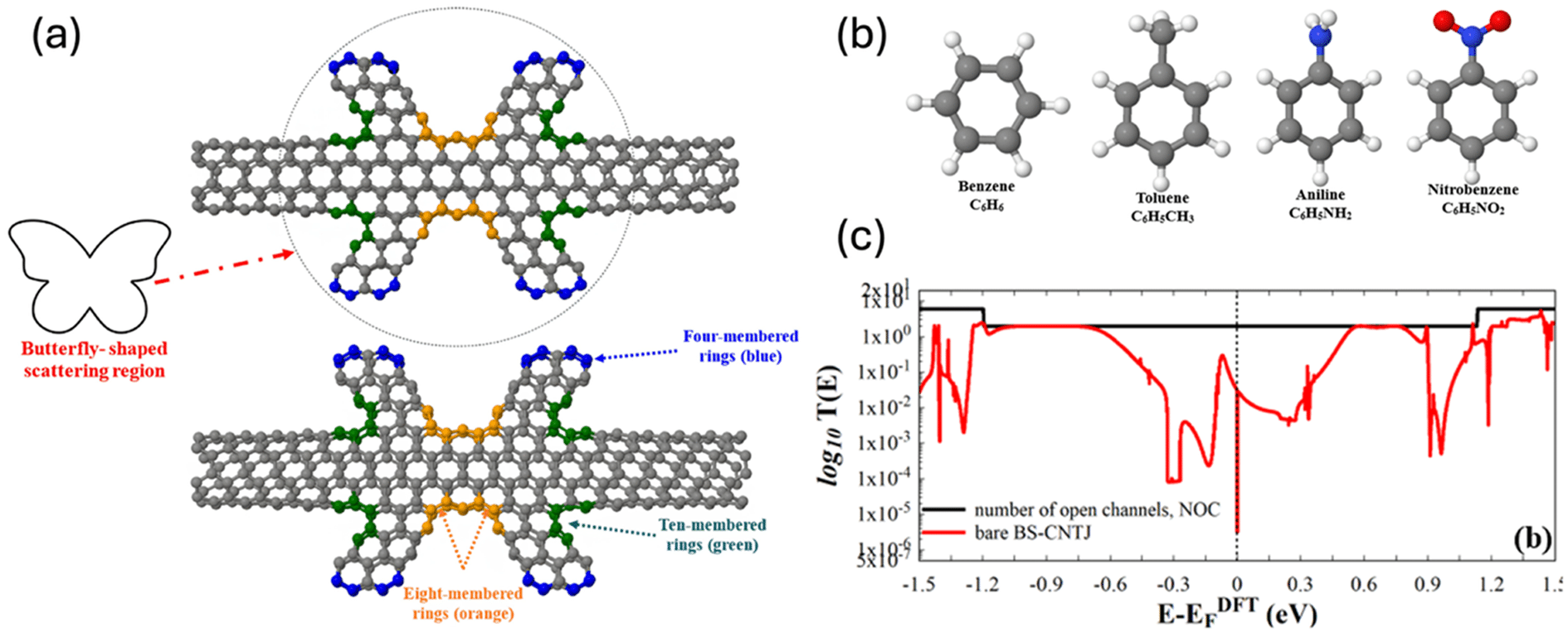
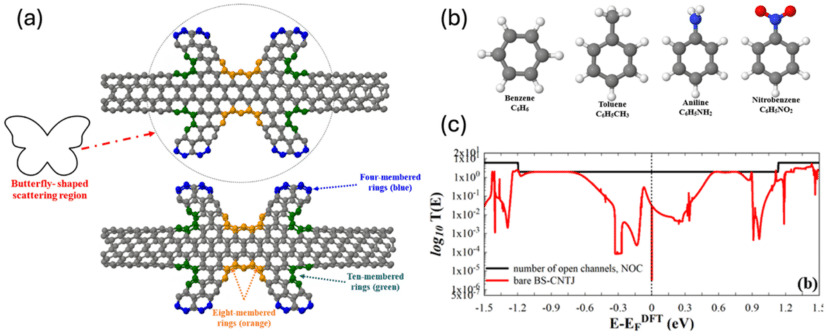
The design of nanosensors with new functionalities can lead to substantial improvements in the detection of different compounds. In particular, the selectivity and sensitivity of nanosensors can be substantially enhanced by using new geometries that increase the detection area and the number of reaction sites, while keeping their size small enough to allow for miniaturization, sensitivity and speed. In this study, we use a novel type of nanoscale sensor with a butterfly shape made from sculpted graphene layers that can detect and differentiate aromatic molecules. Aromatic compounds represent an important family of substances that are often associated with toxic compounds or hazardous pollutants and are widely distributed in the environment and in industrial processes; so, their precise detection, even at very low concentrations, is key for health, industrial safety and environmental monitoring. We show by calculating the electronic, transport and thermoelectric properties that the butterfly shape can give improvements over other types of nanosensors of similar size or composition. First, the molecules adhere strongly to the surface, as demonstrated by the relatively large binding energies calculated, making the combined system sufficiently stable even at high temperatures. Second, the sensor is sensitive enough to accurately distinguish between different types of aromatic molecules that attach to its surface. Third, the sensor can discriminate between different concentrations due to the number of sites available in this particular shape. These factors make this device especially attractive for use as a next-generation, precise, and discriminating nanosensor.