Al2O3-Fe2O3 composites obtained by colloidal processing route and sintered by spark plasma sintering: Microstructure and properties
Publication Details
Journal: Powder Technology 484 (2026) 122939
Authors: Daniel Fernández-González; Marta Suárez; Cecilia Solís; Linda Viviana García-Quiñonez; Pablo García-García; Adolfo Fernández; José Luis Menéndez; Cristian Gómez-Rodríguez
Impact Factor: 5.5
Abstract
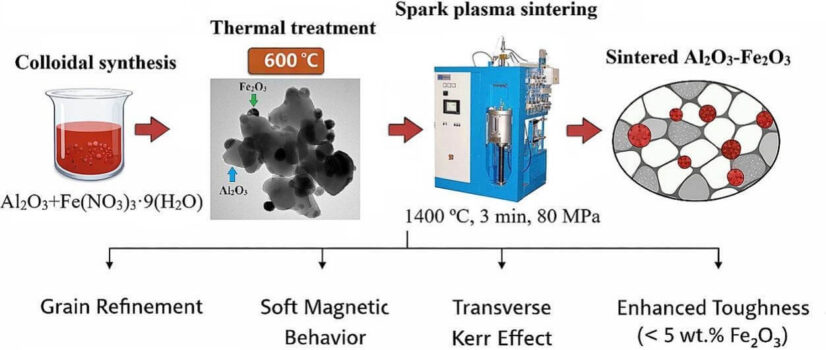
Al2O3-Fe2O3 ceramic composites were prepared for the first time by colloidal synthesis from alumina powder and Fe(NO3)3·9(H2O) using water as the dispersion medium. Doped alumina was treated at 600 °C under air atmosphere to thermally decompose the ferric nitrate and obtain Al2O3 with Fe2O3 nanoparticles on the surface. Five Fe2O3 contents were studied (1, 2.5, 5.0, 10.0, and 20.0 wt%). Monolithic alumina was used as a reference to analyze the influence of the Fe2O3 content on the properties of the composite. Sintering was carried out in a spark plasma sintering (SPS) apparatus under a vacuum atmosphere at 1400 °C for 3 min, with an applied pressure of 80 MPa.
The mechanical and electromagnetic properties of the composites were correlated with the microstructure of the composites. This way, the presence of the Fe2O3 nanoparticles promoted a fine-grained structure, which leads to an increase in the fracture toughness in the case of the composites with <5 wt% Fe2O3. The addition of Fe2O3 is deleterious to the mechanical resistance in the three-point bending test. Regarding electromagnetic properties, all the samples present a soft magnetic behavior with coercive fields. The samples with the largest Fe2O3 content (10 and 20 wt%) show a noticeable transverse Kerr effect, ranging up to 0.15% in the UV region.