
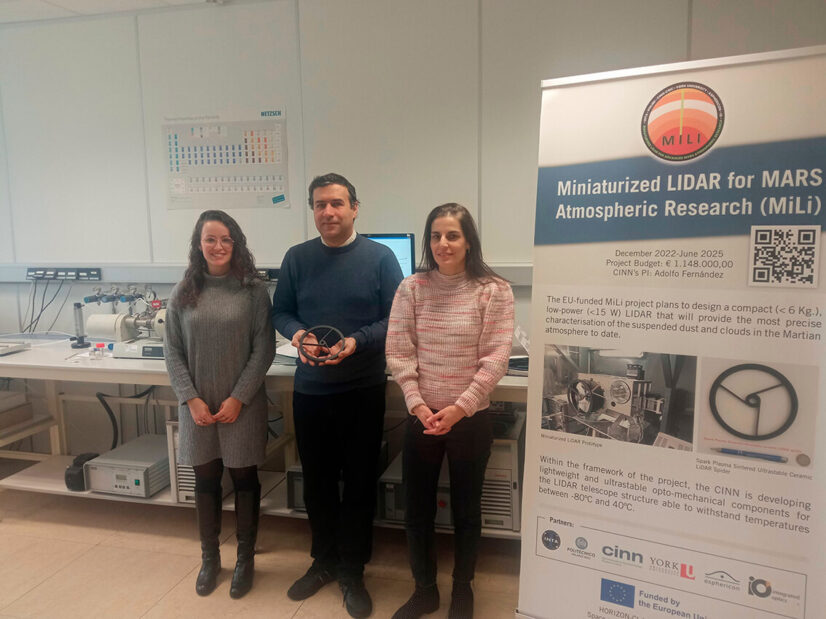
CINN’s ultrastable materials ready to analyze the atmosphere of Mars
The Nanomaterials and Nanotechnology Research Center, a joint centre of the CSIC, the University of Oviedo and the Principality of Asturias, has succeeded in manufacturing and validating innovative opto-mechanical components for future Martian LiDARs.
The work has been carried out within the framework of the European MiLi (Miniaturised LIDAR for MARS Atmospheric Research) project coordinated by the National Institute of Aerospace Technology (INTA).
For a long time, the study of the climate on Mars has aroused great scientific interest due to its importance for future human exploration, but just as on Earth, in order to understand the Martian climate, it is necessary to understand its atmosphere.
Traditionally, studies of the Earth’s atmosphere have been carried out using laser instruments called LiDAR (Light Detection and Ranging), which work by emitting laser pulses and measuring the fraction of energy reflected after impacting the particles that make up the atmosphere. This measurement provides information on aspects such as the distribution, concentration and physical characteristics of suspended particles or the composition of the gases present. However, terrestrial LiDARs are too heavy and consume too much energy for use in space missions.
The European MiLi project, launched in 2022, addressed this problem ‘with a bold approach that involved the development of a LiDAR prototype in which heavy metal components were replaced by innovative ceramic structures that offered high dimensional stability and avoided the use of auxiliary thermal control systems,’ says Adolfo Fernández, CINN’s principal investigator on the project. One of the main technical requirements that a LiDAR must meet in order to function properly is the precise alignment between the laser emitter and the telescope. As Marta Suárez, Senior Scientist at the CSIC at CINN and participant in the project, explains, ‘misalignment of the two instruments would prevent efficient capture of the return signal and compromise the quality of the data collected.’ Therefore, the researcher adds, ‘it is critical to use materials in optical systems that do not undergo dimensional changes within the wide operating temperature range of LiDAR on Mars, between -80°C and 40°C.’
To meet this challenge, the CINN’s Multifunctional Nanostructured Materials research group used a family of materials based on a unique crystalline phase of lithium aluminosilicate, called Beta-Eucriptite, which has a negative thermal expansion coefficient; i.e., contrary to what happens with the vast majority of materials, it expands when cooled and contracts when heated. Using Beta-Eucriptite as a matrix, CINN researchers were able to design and produce, using the innovative Plasma Sintering (SPS) technique, completely dense, large ceramic discs with two chemical compositions, one of which is electrically conductive. This last point proved to be key, as ‘one problem we had not faced at CINN was the costly process of machining these materials, especially given the strict tolerances and complex designs we were aiming for,’ says Noemí López, a pre-doctoral researcher at CSIC-CINN who is developing her thesis on this family of ultra-stable materials. This task, Noemí continues, ‘was successfully accomplished thanks to the use of both electrical discharge machining (EDM) and conventional techniques, making it possible to manufacture for the first time several critical components for the LiDAR, such as the support structure for the telescope’s secondary mirror and the spacers for the emitting laser.’
Translated with DeepL.com (free version)
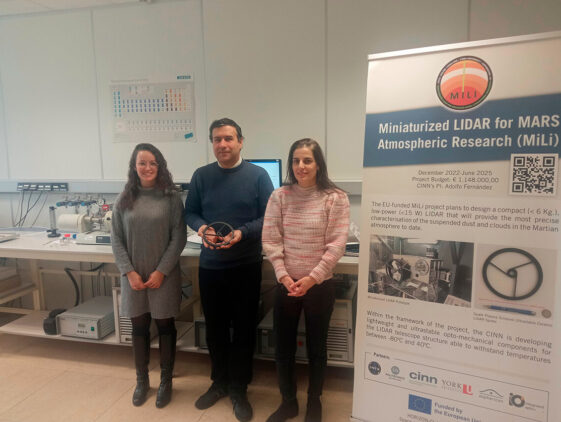
CINN researchers working on the MiLi project show the LiDAR secondary mirror (Spider) support. From left to right: Noemí López, Adolfo Fernández and Marta Suárez. Source: CINN
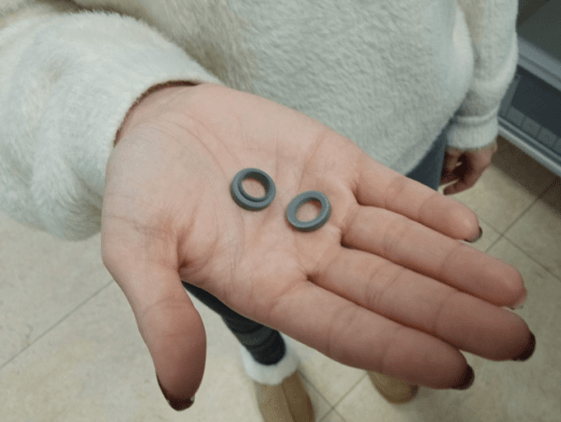
Spacers used in the laser instrument based on new ultra-stable composites and machined by EDM. Source: CINN
LIDAR PROTOTYPE SUCCESSFULLY PASSES FIELD VALIDATION
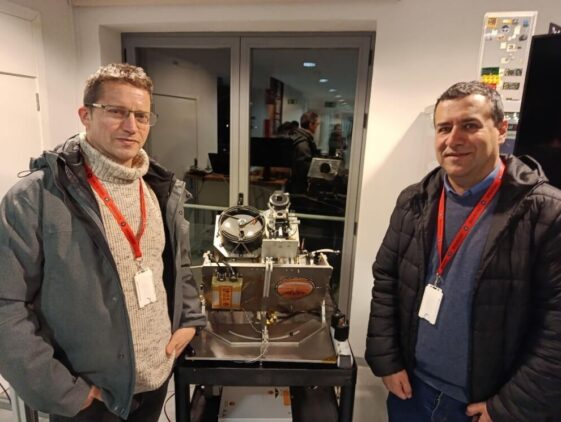
Adrián Alonso (Head of Innovation at CINN) and Adolfo Fernández (Principal Investigator at CINN for the MiLi project) alongside the LiDAR prototype designed as part of the MiLi project, which was presented to the European Commission on 20 January. The image shows the telescope with the Spider manufactured by the CINN.
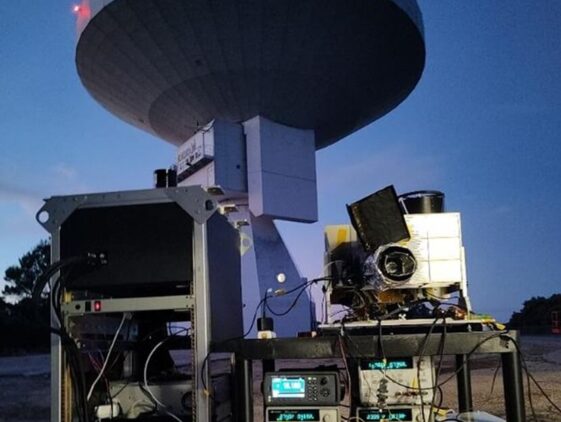
Martian LiDAR prototype (MiLi) on the right; York University LiDAR on the left. Field campaign at the Yebes Observatory. In the background, a 40-metre radio telescope. Source: INTA
ABOUT THE MILI PROJECT
MiLi (Miniaturised LIDAR for MARS Atmospheric Research) is a project funded by the European Commission through the Horizon Europe programme, running from 1 December 2022 to 31 October 2025. The consortium was formed by the National Institute of Aerospace Technology-INTA (Coordinator) and the Nanomaterials and Nanotechnology Research Center (CINN-CSIC) in Spain; the Polytechnic University of Milan (POLIMI) in Italy and York University (YORKU) in Canada; and the companies Asphericon GmbH in Germany and Integrated Optics, UAB-IO in Lithuania.