Scientists at the Sarcomas and Experimental Therapies Laboratory develop an effective nanotherapy for chemoresistant osteosarcomas
Researchers at the Sarcomas and Experimental Therapies Laboratory, led by Dr René Rodríguez, have developed a therapy based on the nanoencapsulation of ruthenium compounds that is more effective and safer than the standard therapies used in the treatment of osteosarcomas.
Dr René Rodríguez, a CSIC Tenured Scientist, has recently joined the Epigenetics and Nanomedicine Group of the CINN, where he will head the Sarcomas and Experimental Therapies Laboratory. This laboratory is also part of the Health Research Institute of the Principality of Asturias (ISPA) and the University Institute of Oncology at the University of Oviedo (IUOPA).
New hope in the fight against the most common form of bone cancer
Osteosarcoma is the most common type of bone cancer and mainly affects children and young people. It is a highly aggressive tumour and becomes particularly difficult to treat when standard drugs cease to be effective.
The problem with current treatments
At present, one of the main treatments relies on platinum-based drugs, such as cisplatin. Although it works well for many patients initially, it has two major drawbacks:
- Serious side effects: It can cause damage to the kidneys and the nervous system, amongst other problems.
- Drug resistance: Many tumours are immune to this drug from the outset, or become resistant over time, meaning it ceases to be effective.
Ruthenium: a promising alternative
To overcome these problems, scientists are researching new drugs based on another metal: ruthenium. The advantages of these compounds are very promising, as they effectively target tumours whilst being far less harmful to the body’s healthy cells than traditional chemotherapy.
A major breakthrough: ruthenium in ‘invisible capsules’ to combat drug-resistant cancer
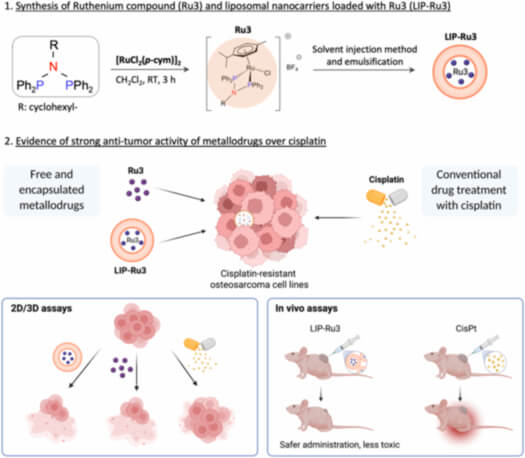
The study, published in the journal Drug Delivery, analyses the behaviour of a new ruthenium-based drug (called Ru3) and an improved version of it (LIP-Ru3), encapsulated in liposome spheres that facilitate their transport through the bloodstream and allow for the controlled release of ruthenium into tumour cells.
The research findings are very promising:
- High efficacy in the laboratory: Both options demonstrated a powerful ability to destroy cancer cells in laboratory cultures.
- Overcomes resistance to chemotherapy: The ruthenium compounds performed better than traditional cisplatin, successfully attacking tumours that had already become immune to standard treatments.
- Success in living organisms without serious side effects: When tested on animals, the microencapsulated formula (LIP-Ru3) managed to halt the growth of resistant tumours without causing any side effects or toxicity to the body, unlike cisplatin.
A collaborative success
In this study, the team from the Sarcomas and Experimental Therapies Laboratory was supported by researchers from the University of Castilla-La Mancha, the Central University Hospital of Asturias, the Biobank of the Principality of Asturias and the University of Oviedo.
Reference:
Murillo, D., Domínguez-Jurado, E., Huergo, C., Gallego, B., Díez, P., Ferreras, A., … Rodríguez, R. (2026). Liposome-mediated delivery of a ruthenium-based metallodrug to overcome cisplatin resistance in osteosarcoma. Drug Delivery, 33(1). https://doi.org/10.1080/10717544.2026.2671485