Acetatobis(l-arginine)copper(ii) acetate trihydrate: synthesis from l-argininium acetate, structural-electronic insights and in vitro antimicrobial activity
Publication Details
Journal: RSC Advances
Authors: Amani Direm, Salima Samai, Hamza Athmani, Mohammed S.M. Abdelbaky, Cemal Parlak, Olufunso Abosede, Santiago García-Granda, Ponnadurai Ramasami
Impact Factor: 6.1
Abstract
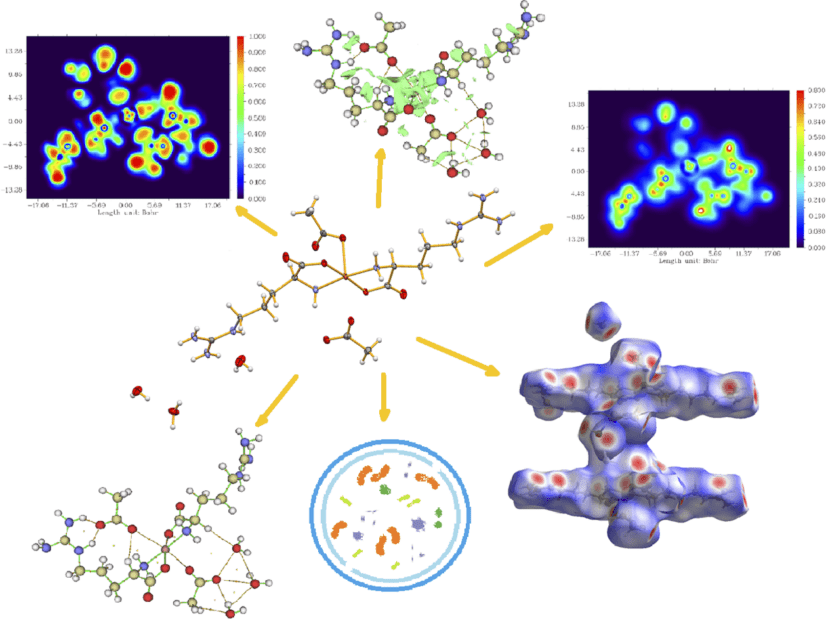
Acetatobis(l-arginine)copper(ii) acetate trihydrate, [Cu(OAc)(Arg)2](OAc)·3H2O (compound II), was synthesized via a complexation reaction using l-argininium acetate (compound I) as the precursor. Single-crystal X-ray diffraction analysis showed that both compounds crystallize in the monoclinic space group P21. A detailed structural analysis revealed a robust 3D hydrogen-bonding network, where lattice water molecules and free acetate anions act as structural bridges, stabilizing the guanidinium side chains of the arginine ligands. A thorough Hirshfeld surface (HS) analysis, quantifying the contribution of N–H⋯O and O–H⋯O H-bonds in addition to non-classical H⋯H, H⋯C/C⋯H and H⋯N/N⋯H contacts to the overall lattice stability, was employed to explore the intermolecular interactions within the crystal structure in comparison with DUYCAB’s.
The electronic properties and the nature of the bonds in (II) were investigated using topological analysis (QTAIM). Furthermore, reactivity descriptors, molecular electrostatic potential (MEP), electron localization function (ELF), localized orbital locator (LOL), non-covalent interaction index (NCI) and reduced density gradient (RDG) of the studied complex were calculated and analyzed. Finally, the biological behaviors of complex (II) and its starting material (I) were evaluated by carrying out in vitro antimicrobial assays against a panel of pathogenic bacterial and fungal strains.
The results demonstrate significant inhibitory activity, suggesting that the integration of the bioactive l-arginine moiety with the copper(ii) centers may lead to enhancing the pharmacological profile of the precursor. This work provides a structural and theoretical framework for the development of arginine-based metal complexes as candidates for next-generation antimicrobial drugs.